
Air Conditioning Installation in Fort Lauderdale, FL: A Complete Step-by-Step Guide

Thinking about replacing your air conditioner but not sure what the installation process actually looks like?
At BW Air Conditioning, we believe homeowners should know exactly what to expect before, during, and after a new AC installation.
This guide walks you through our complete air conditioning installation process in Fort Lauderdale, FL — from the first estimate request and on-site evaluation to installation day, system testing, your final walkthrough, and ongoing support after the job is complete.
Whether your current system has failed, you are planning a remodel or addition, or you are installing HVAC equipment in new construction, the process starts with properly evaluating the property and choosing the right system for the space.

Step 1: Call or Request an Estimate
The first question we ask is which of three situations you are in, because each one leads to a different visit. A failing or failed system means we are working around existing equipment, existing ductwork and an existing electrical setup, and speed usually matters. A remodel or addition means the cooling load of the building is changing, so the old equipment size is no longer the right answer. New construction means we are designing from plans rather than from what is already there.
A few details on this first call save real time later. Roughly how old the system is. What it is doing or not doing — no cooling at all, cooling weakly, cycling constantly, leaking, tripping a breaker. Whether any rooms have always been a problem, because a comfort complaint that predates the failure is usually a duct or a sizing issue rather than an equipment issue. Whether the property is a single-family house, a condo, or a commercial space, and on which floor. And whether anyone has worked on it recently.
This is also the right moment to check who you are talking to. In Florida, air conditioning contracting is a licensed trade, and you can look up any license number yourself through the state's Verify a Licensee search at the Department of Business and Professional Regulation. Ours is CAC029407. Estimates for air conditioning installation in Fort Lauderdale are free.
Step 2: The On-Site Evaluation and 30-Point Inspection
A technician comes out and looks at two things: the building, and the system currently in it. Nobody can do this over the phone. A price quoted without anyone setting foot in the property is a guess dressed up as a number, and the gap between the guess and the real job is what turns into a change order later.
On the building side we are recording square footage and ceiling height, which way the house faces and where the glass is, window area and glazing type, insulation levels, attic condition and temperature, and how the space is actually used — a west-facing room with a wall of glass behaves nothing like an interior bedroom.
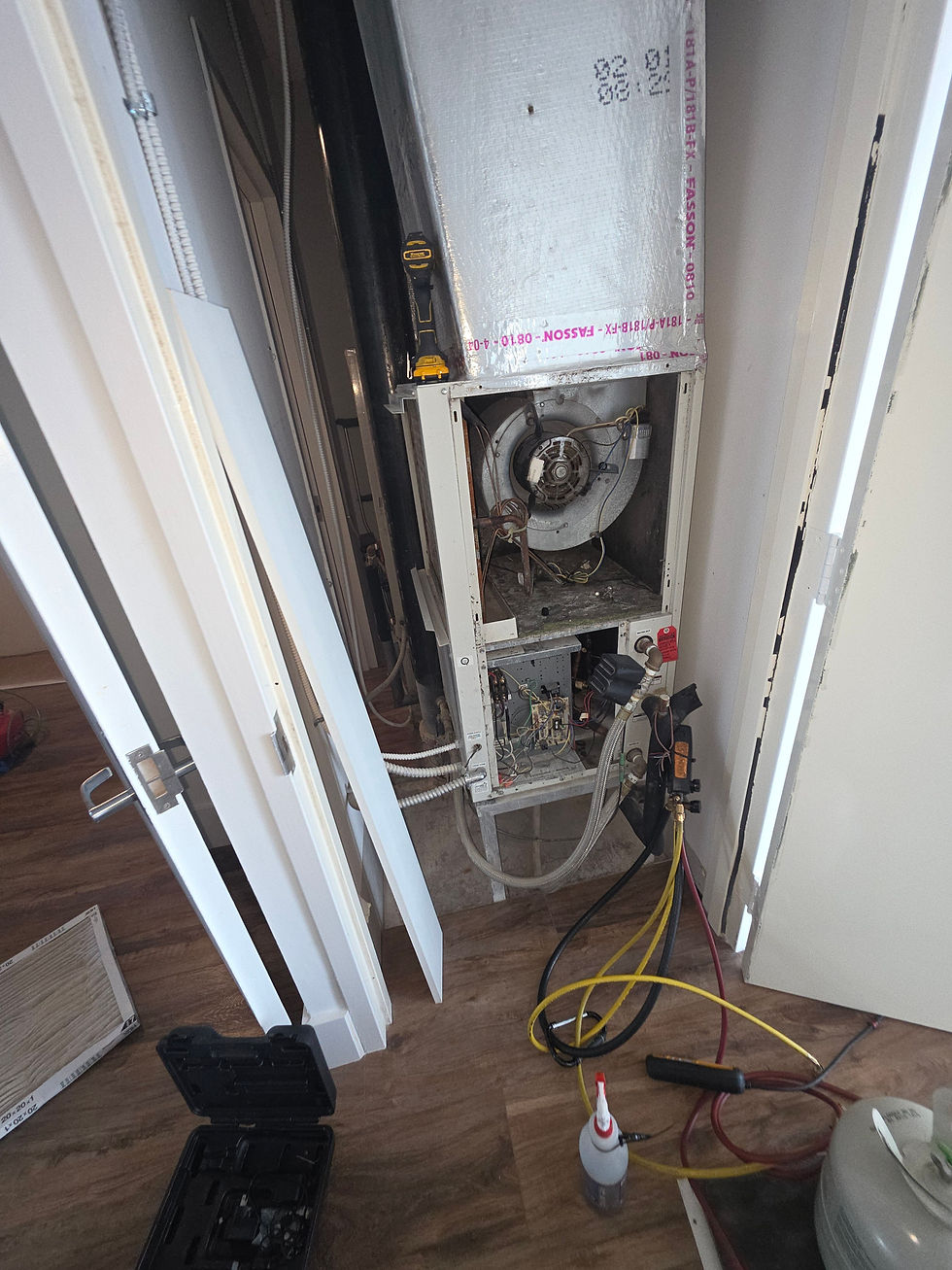
On the system side we look at the existing equipment and its age, the condition and sizing of the ductwork, the return air path, the electrical service and available breaker capacity, how the condensate drain is routed and whether it has been backing up, the pad or roof curb the outdoor unit sits on, and the clearances around it. We also check the access route — the path the old air handler comes out and the new one goes in, which on a second-floor closet or a tight attic hatch is a real part of the labor.
The visit includes a full 30-point system inspection. Inspecting a system we may be about to remove sounds redundant, and it is not. The readings tell us why it failed, and that matters — a compressor that died because the condenser coil was packed with salt and debris is a maintenance story, while one that died because the unit was two tons oversized and short-cycled for twelve years is a sizing story. If we do not find that out now, the new system inherits the same problem.
All of that feeds the sizing calculation. The industry standard for residential load calculation is ACCA Manual J, which sizes equipment from the building rather than from whatever was there before. This matters more in South Florida than almost anywhere else, because our load is as much humidity as heat. An oversized system satisfies the thermostat quickly, shuts off before it has run long enough to pull moisture out of the air, and leaves you with a house that is 74 degrees and clammy. Bigger is not safer here; it is the single most common way a new installation disappoints its owner.
Step 3: Your Clear, Written, Flat-Rate Quote
Flat-rate means the number on the page is the number you pay for the scope described, not a starting point that moves once the work begins. A quote worth signing should name the equipment specifically — manufacturer, model, tonnage and efficiency rating, not just "new 3-ton system" — and should spell out labor, materials, the permit, removal and disposal of the old equipment, the thermostat, and system startup.
You will usually get more than one option. Because we install and service every major brand, we can put a good, better and best choice in front of you and explain what the extra money buys — higher efficiency, variable-speed operation, better humidity control, a longer parts warranty — rather than steering you to whichever line we happen to stock. And if the honest answer is that a repair makes more sense than a replacement, we will say so.
The line items that turn into surprises on other quotes are duct modifications, electrical upgrades, condensate drain rework, and pad or roof-curb work. These are not hidden fees when they are disclosed up front; they become hidden fees when a low number wins the job and the extras appear on installation day. If the evaluation in Step 2 tells us any of them are needed, they are on the quote before you sign anything. Financing is available with as little as $0 down, which is worth asking about while you are comparing options rather than after.
If you are gathering competing bids, our shorter overview of what the whole AC installation process looks like is a useful checklist to read alongside them.
Step 4: Installation Day
Most standard residential changeouts are a single day. The job runs longer when ductwork is being replaced, when the electrical service needs work, when access is difficult, or on commercial jobs where equipment has to be craned onto a roof. You should be told which of those applies to you before the day arrives, not during it.
The crew starts by protecting the work area and the route between the door and the equipment — floor coverings, drop cloths, and a clear path for carrying an air handler through your hallway. Then the old system comes out. Refrigerant has to be recovered into a cylinder with proper equipment rather than vented to the atmosphere; that is federal law under EPA Section 608, and the technicians handling it are certified under it. The old equipment is hauled away and disposed of properly.
Then the new system goes in. The air handler is set and leveled so the condensate pan drains the way it is supposed to. The outdoor unit is set on its pad and secured with hurricane tie-downs to Florida Building Code — the straps visible in the photo above are not optional in Broward County. The refrigerant line set is brazed, pressure-tested, pulled into a deep vacuum to remove moisture and non-condensables, and then charged to the manufacturer's specification rather than by feel. The condensate drain and float switch are set up, the electrical is landed at the disconnect and the air handler, and the thermostat is wired and programmed.
Ductwork is its own decision point. A new system pushing air through leaking or undersized ducts gives back a good share of what you paid for in efficiency, so if the evaluation flagged problems, duct repair, sealing or replacement happens while the system is open and accessible, which is far cheaper than coming back for it later.
Replacing an air conditioner is permitted work. A licensed contractor pulls the permit in their own name and meets the inspector, and the inspection is what independently confirms the installation met code. Depending on where the property sits, the permit comes from the city or from the Broward County Building Code Division — many Broward cities issue their own. Anyone offering to skip the permit is offering to transfer the liability to you, and it tends to surface later when you sell the house.
Two practical notes about the day itself. Power to part of the property will be off for stretches of it, because working on live equipment is not safe. And it is loud — there is cutting, brazing, and metal being moved. Neither is a sign anything is wrong.
Step 5: Testing and Walkthrough
An installation is not finished when the system turns on. It is finished when it has been commissioned — run and measured. The readings taken with the system running are the temperature split between return and supply air, static pressure across the air handler, the refrigerant charge verified by subcooling or superheat, compressor and blower amp draw against their rated figures, and airflow at the registers. Those numbers are also the baseline that future maintenance visits get compared against, so they are worth having written down.
Then the walkthrough. You should leave it knowing your filter size and where it goes, how often to change it, how to work the thermostat including any scheduling or app setup, where the breaker and the outdoor disconnect are, where the condensate drain access is, and what the system sounds like when it is running normally — so you can tell when it is not.
You should also leave with paperwork: the invoice, the permit number, the equipment model and serial numbers, and confirmation that the manufacturer's warranty has been registered. That last one matters more than it sounds. Most manufacturers require registration within a set window after installation — commonly 60 or 90 days — and missing it can quietly cut a ten-year parts warranty down to five.
Step 6: Ongoing Support
A South Florida air conditioner barely gets an off-season. It runs most of the year against heat, humidity and — near the coast — salt air that corrodes condenser coils faster than inland equipment ever sees. Maintenance is what keeps the commissioning numbers from drifting, and most manufacturer warranties also require documented annual service to stay valid, so skipping it can cost you twice.
The practical advantage of staying with the company that installed the system is that we already know it — the equipment, the ductwork, the drain routing, and the baseline readings from day one. When something does need attention, AC repair in Fort Lauderdale comes from the same company, with the same records. That is what we mean by being your AC repair and installation company in one call.
How to Prepare for Installation Day
None of this is required, and all of it makes the day shorter:
Clear the path. Move furniture, rugs and breakables out of the route between the entry door and the air handler, and clear a few feet around the outdoor unit.
Plan for the power being off. Charge what you need charged, and do not plan a work-from-home day that depends on uninterrupted power in that part of the house.
Secure pets and keep kids clear. Doors will be propped open and there will be tools and sharp sheet metal on the floor.
Empty the closet or attic access. Anything stored around the air handler or under the attic hatch has to move anyway; moving it yourself keeps it where you want it.
Settle thermostat questions in advance. If you want it moved, or want a smart thermostat and Wi-Fi access for it, decide before the crew arrives.
Be available at the end. The walkthrough is the most useful twenty minutes of the whole project, and it only works if someone is there for it.
Frequently Asked Questions
How long does the whole process take, from first call to a running system?
For a straightforward residential replacement, often just a few days — the evaluation and quote can happen quickly, and the installation itself is usually one day. What stretches the timeline is equipment availability on a specific model, ductwork or electrical work added to the scope, condo or HOA approval requirements, and commercial jobs that need rooftop access. If your system has failed completely in the middle of summer, say so when you call.
Do I need to be home for the entire installation?
Someone needs to let the crew in and be reachable during the day, and someone should be there at the end for the walkthrough. You do not need to supervise the middle of it.
Who pulls the permit, and is it an extra charge?
We pull it, in our name as the licensed contractor, and we meet the inspector. The permit is a line item on your written quote, so you see the cost before you sign rather than after.
Will my existing ductwork be reused?
Often, yes, if it is correctly sized, sealed and in good condition. It gets inspected during the evaluation rather than assumed. Where the ducts are leaking, crushed, or too small for the new equipment, we will show you what we found and quote the fix, because a well-installed system on bad ductwork still underperforms.
What happens if something goes wrong after the installation?
You call us. New equipment carries a manufacturer's parts warranty, and workmanship is our responsibility — that is the whole point of using one company for installation, maintenance and repair rather than three. We have the commissioning readings from day one to compare against, which usually makes the diagnosis much faster.
Ready to Get Started?
BW Air Conditioning has installed and serviced air conditioning systems across Fort Lauderdale and Broward County for more than 30 years under Florida license CAC029407.
If you’re considering replacing your AC system, start with a professional on-site evaluation so we can properly assess your home, existing equipment, ductwork, and cooling needs.
Call (954) 565-7369, schedule service online, or learn more about our AC ins

We are here to help you!
Phone: (954) 565-7369
Email: cald2909@bellsouth.net
Website: bwairconditioning.com
If you have questions or need air conditioning service in Fort Lauderdale, reach out to BW Air Conditioning.


Comments